About Me

Education:
Stanford University
    PhD in Physics (expected 2029)
    NSF Graduate Research Fellow
University of Florida
    Bachelor of Science in Physics, Astrophysics, and Mathematics (2024)
    magna cum laude

Research Interests:
Broadly speaking, I am interested in theoretical and observational cosmology. My primary focus is combining information from the Cosmic Microwave Background (early Universe) with surveys of large-scale structure (late Universe). I am a member of the Large Synoptic Survey Telescope (LSST) Dark Energy Science Collaboration.

Publications:
Google Scholar

About Me:
I am a Florida native, born and raised in Tampa, FL. After graduating high school, my identical twin brother and I moved to Gainesville, FL and attended the University of Florida (Go Gators!). At UF, I was a Platinum Presidential Scholar, triple majored in physics, astrophysics, mathematics, and minored in theater. My interest in cosmology formed by researching higher-order statistics for galaxy clustering with Prof. Zack Slepian at UF and spending a summer researching reionization with Prof. John Wise at Georgia Tech.

Following my graduation at UF in 2024, I traveled across the country to the other "Bay Area" to attend Stanford University, where I am now working towards my PhD in Physics. I am proud to be a member of the Kavli Institute for Particle Astrophysics and Cosmology (KIPAC), the greatest place in the world to be doing astrophysics (I'm not biased!). Outside of work, I love watching the latest movies in theaters, seeing musicals and plays, exploring San Francisco, and solving crossword puzzles. My go-to fun fact is that not only am I a twin, but also both of my parents are!

If you are interested in working with me or would just like to chat, feel free to reach out!
Research

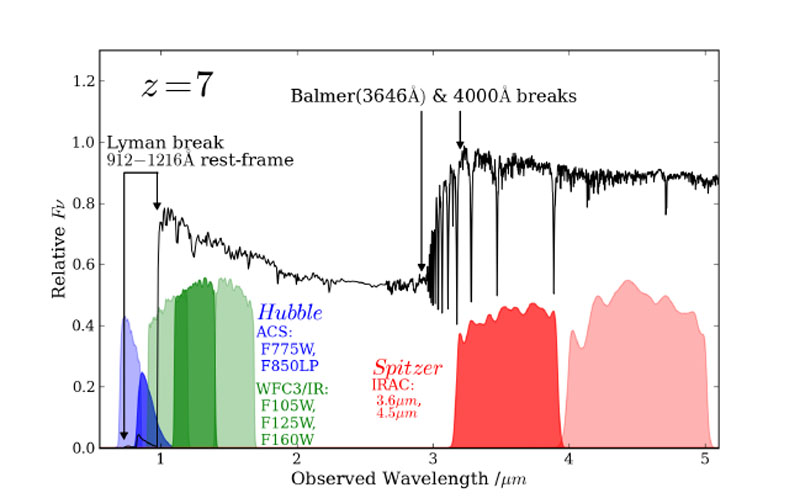
Photometric Redshift Requirements for CMB Lensing x Lyman Break Galaxies
LSST has very strict requirements for photo-z calibration at low redshifts because decades of work have led to very good constraints and modeling at low redshifts. Higher-redshift cosmology is relatively unconstrained, however, and we can likely still get very interesting science out with relaxed photo-z calibration. Just how much we can relax our photo-z requirements is still unknown. The answer to this question will be very impactful for planning out future Lyman Break Galaxies analyses with LSST.

Modified 3x2 Point Analysis
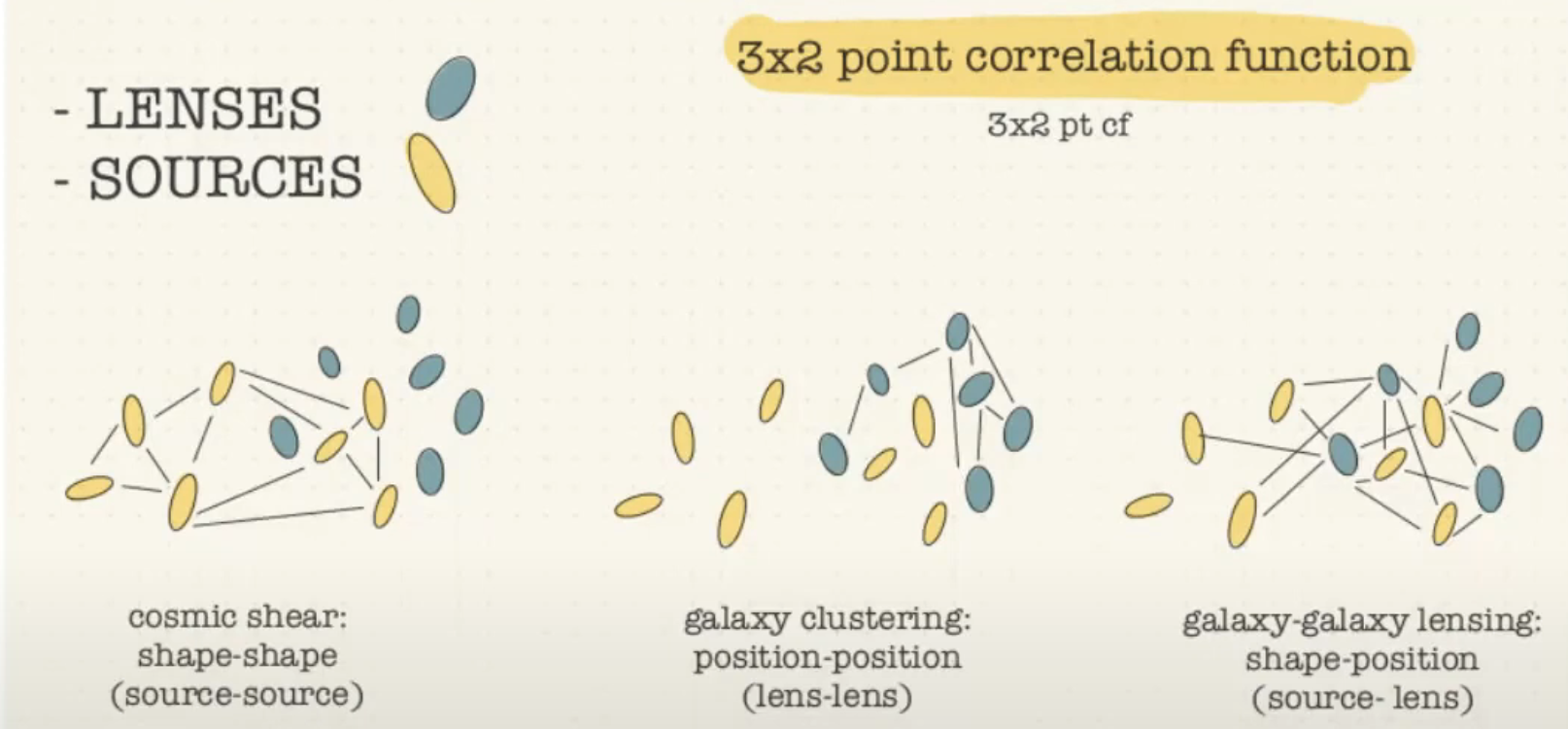
The standard 3×2 point analysis combines galaxies into broad lens and source samples and correlates each possible combination of samples (lens-lens, lens-source, source-source). By instead splitting galaxies by properties like color or luminosity before the 3×2 analysis, we may break degeneracies and gain extra constraining power. Testing how much this improves cosmological information will help guide future LSST large-scale structure analyses.

Community

Teaching:

  • I taught Physics 44 (Electricity and Magnetism Lab) and Physics 16 (The Origin and Development of the Cosmos) and received teaching evaluation socres of 4.7/5 and 5/5, respectively.
  • I mentored Stanford undergraduates through the Directed Reading Program. In this program, I helped students understand a cosmology paper (DESI DR2 BAO results) and gave lectures about introductory cosmology.

Leadership/Outreach:

  • I am an executive member of the Graduate Students of Applied Physics and Physics organization, where I create social events for students.
  • I am a tour guide for SLAC National Accelerator Laboratory, where I give public and educational tours.
  • I have written guest posts for Astrobites to explain astrophysics papers at an undergradute level.

Equity & Inclusion:

  • I am the program manager of Stanford PIE (Physics Inclusion and Equity), a program that assists underpriviledged undergraduates applying to graduate school.
  • I served on a panel for Ethics in Physics, where I discussed multifaceted issues in physics.
  • I am part of the Letters to a Pre-Scientist program, where I write letters to elementary school students to encourage them to pursue STEM careers.

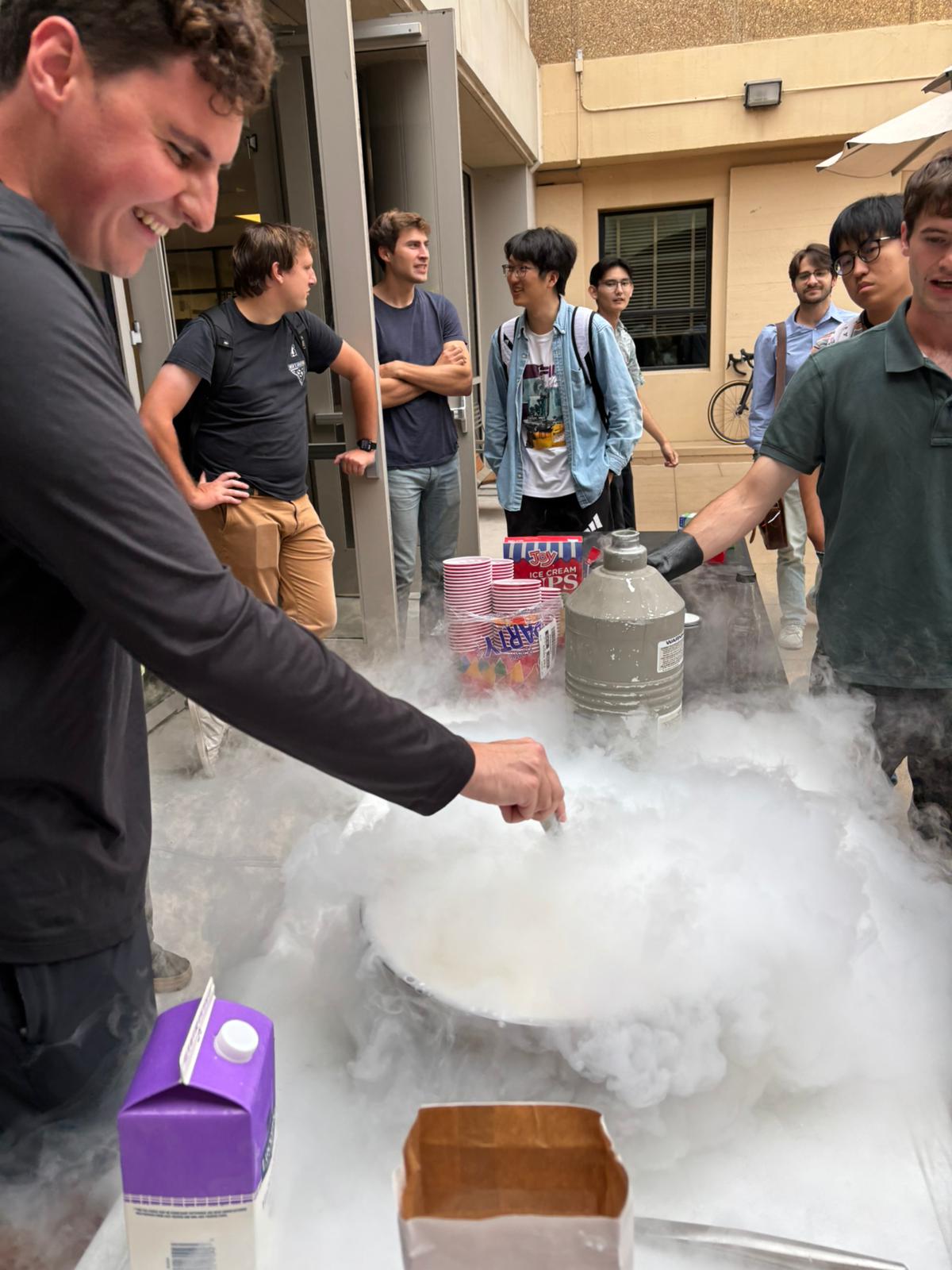
LN2